
Is there anything more comforting than curling up with some popcorn and watching a great film? Although we might choose a movie or TV series for the actors, the director, or even where it was filmed, the real magic happens at the very first inception: the script. That’s the power of a great screenwriter.
If you’ve been wanting to get into the movie business as a writer, this guide is for you. We’ll look at how to write a good screenplay, what makes a script really shine, and how to format a screenplay to discerning industry standards.
What is a screenplay?
A screenplay is a story produced for development in film or TV. They form a blueprint of character interactions, scenes, and visual elements that can be adapted for the screen. Screenplays are tightly structured narratives that rely on action, setting, and dialogue to propel the plot.
“Screenplay” will sometimes be used interchangeably with “script”, although “script” is a broader term that can encompass stage plays as well. Like other storytelling mediums, screenplays can be in any genre. The best screenplays combine a compelling plot with rich, nuanced character development.
You’ll sometimes hear people in the industry talking about “spec scripts” and “shooting scripts”. A spec script is what you, the screenwriter, write in the first stage of the development process. A shooting script is what directors use during filming. They’ll have more detail about exactly how the film will be shot, and both forms still need to follow standard screenplay format conventions.
For now, all you need to worry about is developing your spec script.
How is a screenplay different from a novel?
Although the screenplay and the novel form share lots of common elements, they differ in a few key ways: structure, format, and production.
Screenplays tend to be very rigidly structured, with a definable sequence of plot points that builds to an emotional climax. Many novelists use story structure too, but there’s a bit more creative freedom in how and when you approach each beat.
Visually, screenplays have a very distinct format that adhere to the film industry’s conventions. Lines of dialogue are centered underneath the character’s name, with action and scene setting off to the side. Some of the narrative choices novelists make, like verb tense and point of view, generally don’t exist in the screenplay form (though there are exceptions, particularly when movies incorporate voiceover narratives).
We’ll take a closer look at how to format your screenplay down below.

Another big difference between screenplays and novels, one that really doesn’t get talked about as much, is that novel writing is largely an independent art form, and filmmaking is a collaborative form.
A finished novel is predominantly a product of an single author, with contributions from the editor, proofreader, cover designer, copy writer, typesetter, and more. But even though there’s a team behind every book, a novel is publicly perceived to be the work of one person.
A screenplay or teleplay is shown to the public as an ensemble creation. There are the actors, the director, the producer, the costume designer, the set designer, the makeup artist, and dozens of others all carrying their own vision of the story. The final product will be a composite of all of these visions.
In short, a published novel will look pretty similar to the author’s initial idea. A movie will mutate at every single production level. This can be both frustrating and exciting for screenwriters.
How to write a screenplay, step by step
Ready to start writing your very own screenplay? It’s not as hard as it looks. Following a structured workflow will help you avoid the pitfall of getting stuck in the first few pages.
Step 1: Create interesting and dynamic characters
Whether you’re writing slice-of-life comedy or blockbuster action, the thing that audiences will invest in most is the depth and quality of your characters.
Think about who your protagonist, or main character, will be. Are they static, or dynamic characters who change over time? What do they want most, and what’s standing in the way? What are they afraid of? All of these things will push the story forward.
In addition to your protagonist, you’ll also need a clear sense of the different types of characters in your story:
-
The antagonist. This is the character who’s in opposition to your protagonist. They might be an evil warlord baddie, or simply someone who has different views than the main character. The antagonist’s role is to create conflict.
-
The deuteragonist. This is the most prominent secondary character who supports the protagonist on their journey. This could be a best friend, love interest, family member, and so on.
-
Secondary characters. The amount of secondary characters you have in your film depends on the length and complexity of the story. Secondary characters can be used for comic relief, to provide wisdom and guidance, to create tension, and more.
Some of these characters will have dynamic character arcs, meaning they undergo an internal change over the course of the story. Others may be more one-dimensional, but still serve the narrative. You can learn more about creating effective character arcs here.

Step 2: Draft a detailed outline
Also known as a “beat sheet”. Most movies, including TV episodes, follow the three-act structure or the five-act structure. These are basically different ways of breaking down the same overall story arc with a setup, confrontation, and resolution. Both involve:
-
The exposition, sometimes called the “ordinary world”. This is what’s been going on in your characters’ lives up to the point where the story begins. Who is this person? What do they want? Why should your viewer care about them?
-
The all-important inciting incident, which happens within the first few minutes (if you leave it too long, your audience will start changing channels). This is the cataclysmic event that sets the plot in motion. It might be a negative event, or it might be something that seems positive at first, but turns out to have some unexpected consequences.
-
The rising action, which is all the fallout that happens because of the inciting incident. It connects the first and second acts. This often involves the protagonist flailing around trying to fix things, and inadvertently making things worse.
-
The midpoint. Very important key event that happens, as you may have guessed, in the middle of the movie. This is a little bit like a second inciting incident; it derails the story and sends it spinning in a new direction.
-
Some more rising action. Things are starting to go pretty good. Your character’s getting a handle on things. Maybe everything will work out fine. Until…
-
The crisis! Sometimes novelists call this “the dark night of the soul” (if they’re feeling dramatic) or “the pre-climax” (if they’re embarrassed to say “dark night of the soul” in public). This is where everything in the main character’s life falls to pieces.
-
The climax. This is the big showpiece, the point of highest action and suspense. The moment the audience has been waiting for. You can always tell when it’s the climax because dramatic music starts playing, shots are shorter (usually cutting between various plots and subplots), and everybody’s in a rush to get somewhere.
-
And, finally, the denouement. Also known as “Where do we go from here?”. These last few minutes of the film are used to wrap up and loose ends, say goodbye, and hint at where the characters are headed next. Hint: if you’re writing a movie, the story should wrap up pretty definitively. But if you’re writing a TV pilot, it’s helpful to end on a cliffhanger so that the audience wants to jump into the next episode.
You can find a dedicated lesson that dives deeper into the three-act structure here, and the five-act structure here.
Once you have your story all planned out (this is another difference between screenwriters and novelists; novel writers will often figure things out as they go, while screenwriters are more likely to map a story out in its entirety), write a scene-by-scene list of everything that happens from beginning to end.
Step 3: Set a runtime goal
How long do you want your film to be? Runtimes used to be very strict, especially in TV writing. A thirty-minute sitcom ran for twenty minutes, leaving ten minutes for commercials. A one-hour drama ran for around forty-five minutes, with fifteen minutes for ads and bathroom breaks.
Now that most audiences consume their media through streaming, runtimes are a little more flexible. Audiences are more acclimatized to longer movies than they were twenty or thirty years ago. But, it’s still a good idea to have a sense of what your final runtime will be.

One minute of screen time is around one page of text. This means if you want your film to be ninety minutes long, your script should be around ninety pages (unless you’re Amy Sherman-Palladino, the writer, showrunner, and director who would often tell her actors on Gilmore Girls to “Gilmorize it!”—that meant “talk really fast so we can get more dialogue into our runtime”).
Step 4 (optional): Use a visual storyboard
Storyboarding is an optional step that many writers find helpful in the script writing process. A “storyboard” is essentially a rough comic-book-style layout of your film. Because film is primarily a visual medium, a storyboard forces you to think like a cameraman and envision how each scene would be shot.
You don’t have to be a great visual artist to draw a storyboard. You don’t even have to show it to anyone if you don’t want to. All you have to do is sketch out each scene from the perspective of the camera, paying attention to how each shot moves the story forward.
Don’t be afraid to try out a few ideas and angles as you explore your film. Having this visual aid can make it easier to describe what’s in your head once you begin the final draft of the script.
Step 5: Write a synopsis of each act and scene
Now it’s time to slam out your first draft. Don’t worry about format just yet; instead, write a broad overview of what happens in each act. Start with a one-sentence summary of the main story. This is your premise, or “logline”. Build on this and write a one-paragraph summary of each act.
Then, expand these short summaries into more detailed scene-by-scene breakdowns. Try to include as much detail as you can. This will be very helpful when you get to the “treatment” stage, which is the synopsis you use to pitch your script to production companies.
The synopsis should be written in a fairly objective voice, and in the present tense (She goes, rather than She went). Remember, the audience can’t hear the character’s thoughts (unless they’re delivered through a voice over) the way they can in novels. You can, however, describe body language and facial expressions that hint at what’s happening underneath. Write from the point of view of the camera lens.
Step 6: Transcribe your story into a screenplay format
Now that you have your full, amazing story written down, it’s time to turn it into a screenplay. Following film script conventions is important for a few reasons: it clearly tells the actors and crew what to do with your words, presents you as a professional writer who knows their craft, and increases your chance of getting your script seen.
Next we’ll look at precisely how to do that, with a few examples.
How to correctly format a screenplay
Knowing how to properly format a polished screenplay is essential if you want the industry to take you seriously. There is screenwriting software available, but it’s a good idea to know how to do it on your own, too. Let’s break it down.
Start by establishing the scene
Start by double spacing your text and adding the page number to the upper right corner of the page. Margins should be one inch all around, except for the left margin, which is one and a half inches. Then, begin your opening scene.
Most screenplays begin inside or outside somewhere. If it’s inside, use the scene heading “Int. [location]” (“Int” is short for “interior”). If it’s outside somewhere, use “Ext” (“Exterior”).
Then, follow up your heading with a short description of the important visual elements, written in present tense. (Note also that this is all written in Courier, a legacy convention that will remain on this earth as long as the cockroaches.) This is what the opening looks like in The Sixth Sense:

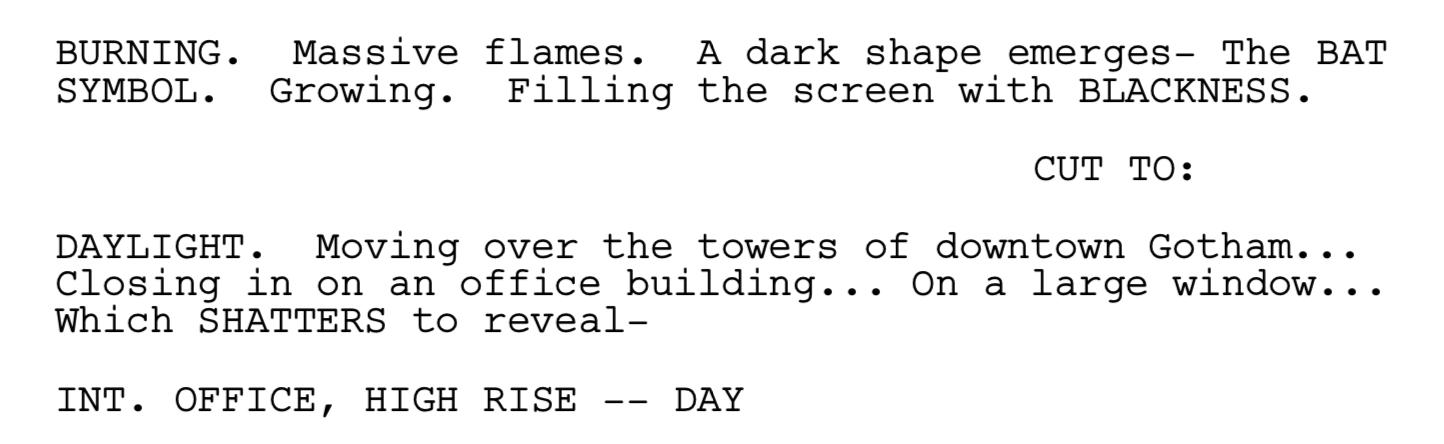
If your initial setting isn’t quite inside or outside, or it’s a combination of different things, briefly describe it in the opening lines. Be sure to establish the setting as soon as it becomes more specific. This is the beginning of The Dark Knight:
You can also use your opening lines to set the film’s tone. This is the opening to the action-thriller The Bourne Ultimatium:
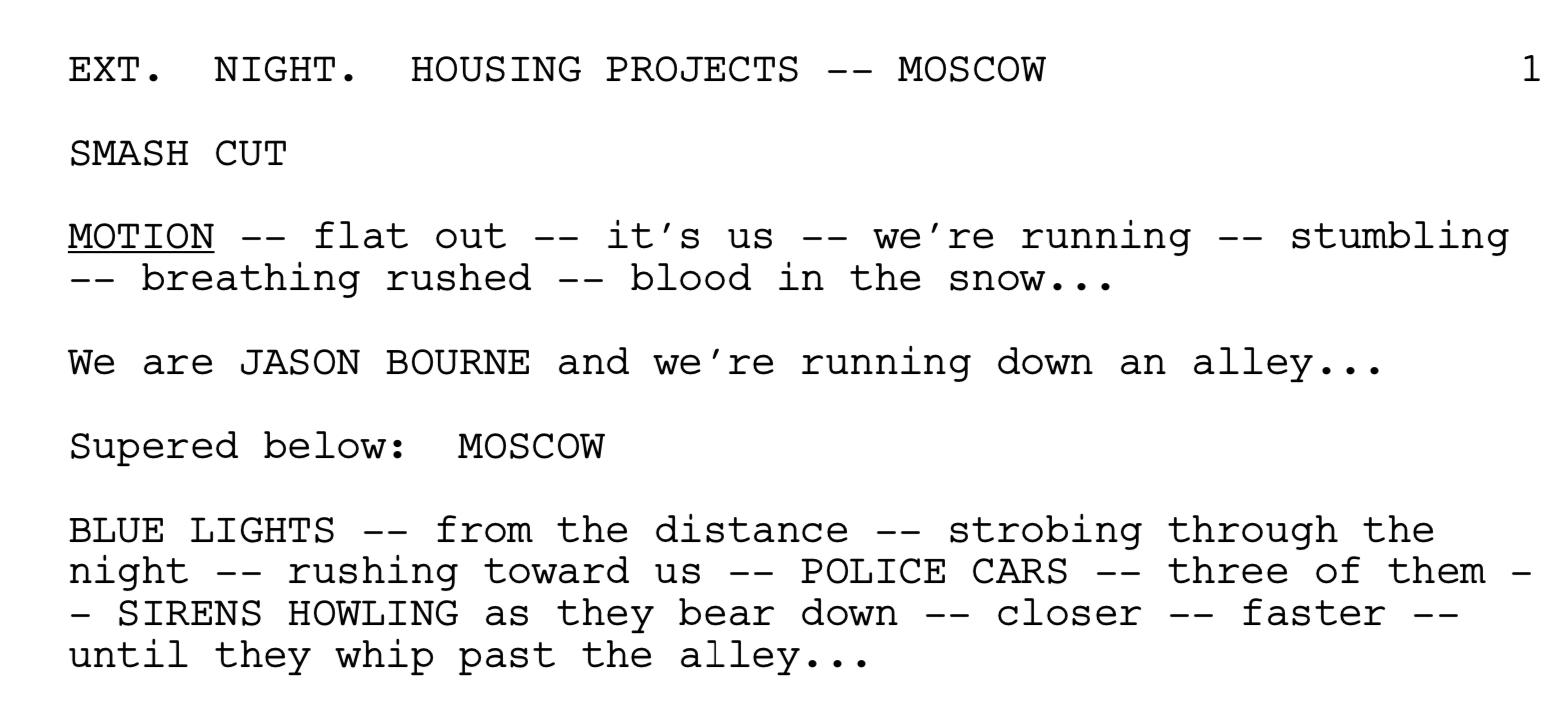
You can see how the action descriptions and erratic language create an urgent, chaotic mood.
Introduce your characters
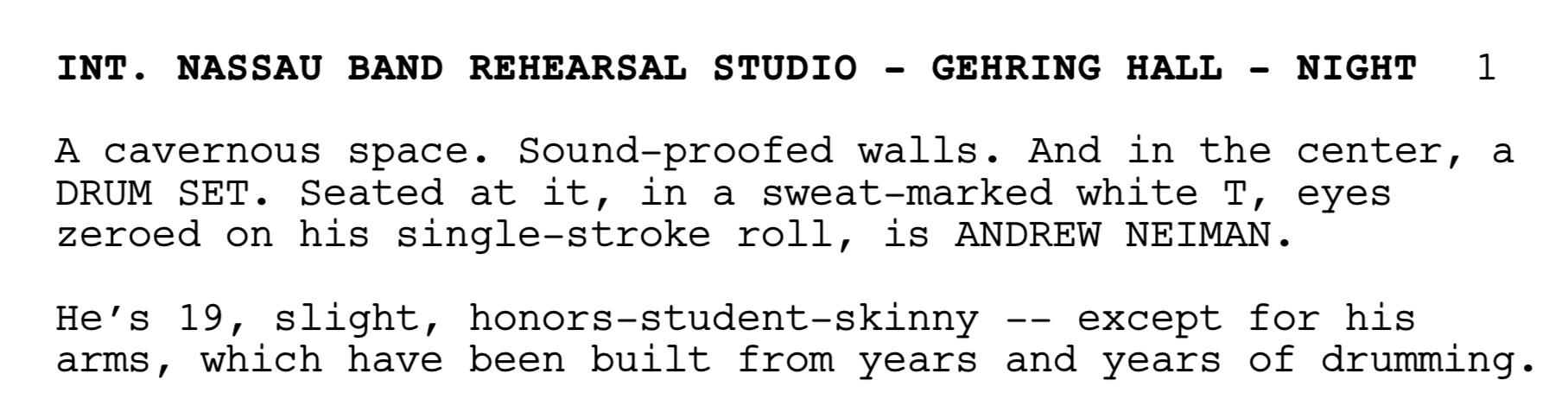
Once you’ve oriented the audience in the setting, introduce and describe the person or people in this scene. This might be your main character, or someone else. Character introductions should be in capital letters, followed by a short objective description. This is how it looks in Whiplash:
You might stay on this character for a while, or introduce a second character. This follows the same format. Pretty soon, you’ll have some dialogue:
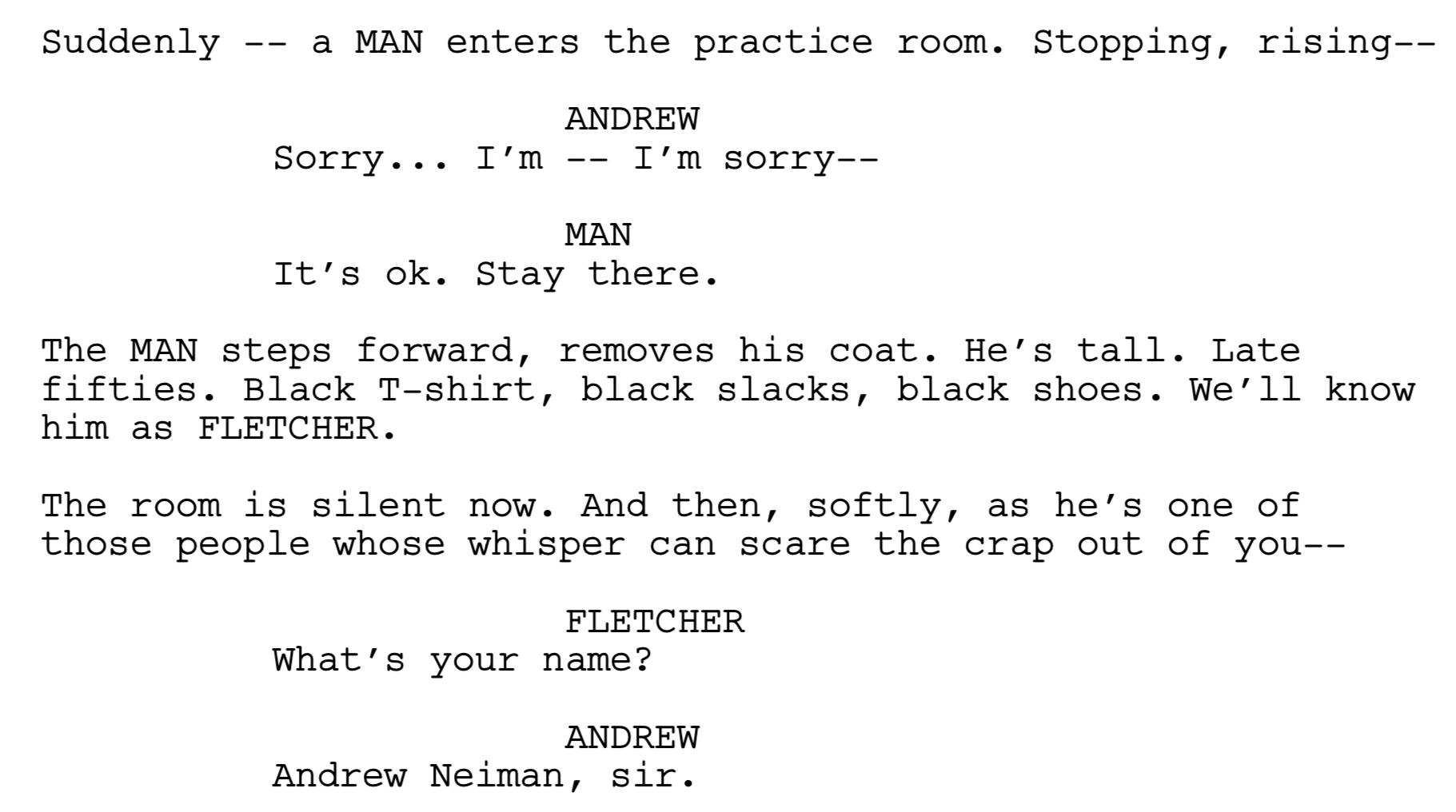
Notice how the dialogue is all centered underneath the name of the character speaking, which is capitalized. Script dialogue doesn’t use quotation marks the way novels and short stories do. Keep dialogue sharp and to the point. Remember that the most effective dialogue often relies on what’s not being said, or the subtext.
There are a few action lines in between the dialogue to show what the characters are doing and the impressions they give. If the same character keeps talking after an action beat, you’d add “CON’T” (“continued”) after their name.
You can also add some adverbs and interiority to your dialogue, like this:
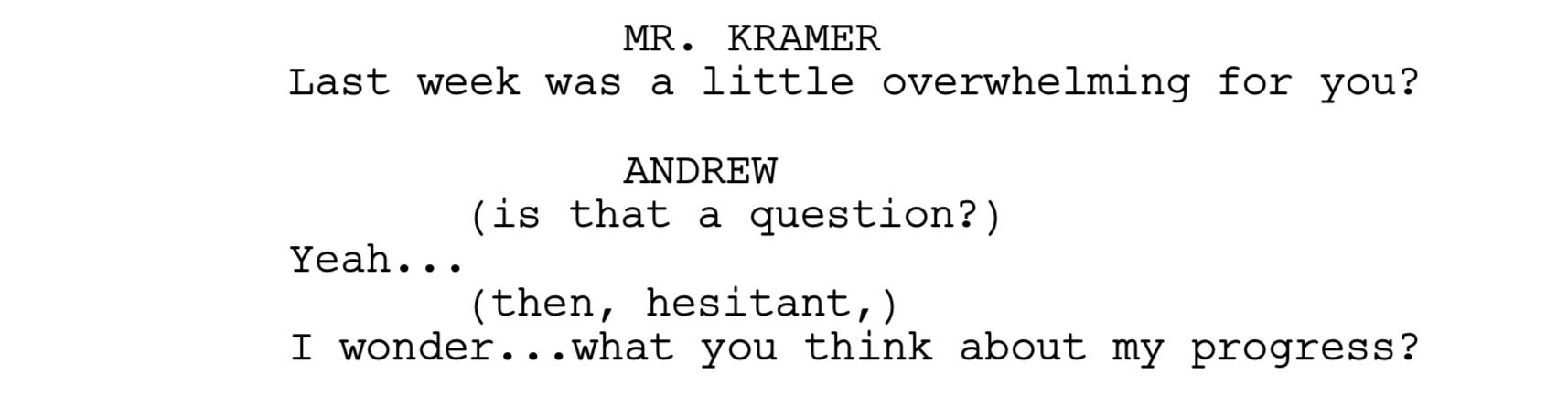
This should be done sparingly, though. Actors like to find their own interiority, and they can get a bit grumpy when the screenwriter tries to do it for them.
Then, connect your scenes
You may have noticed a few scene transitions here, like “CUT TO”. These are aligned on the right. There are other transitions you can use too, like “FADE IN” or “DISSOLVE TO”. Here’s an example from the opening voiceover montage in The Fellowship of the Ring:
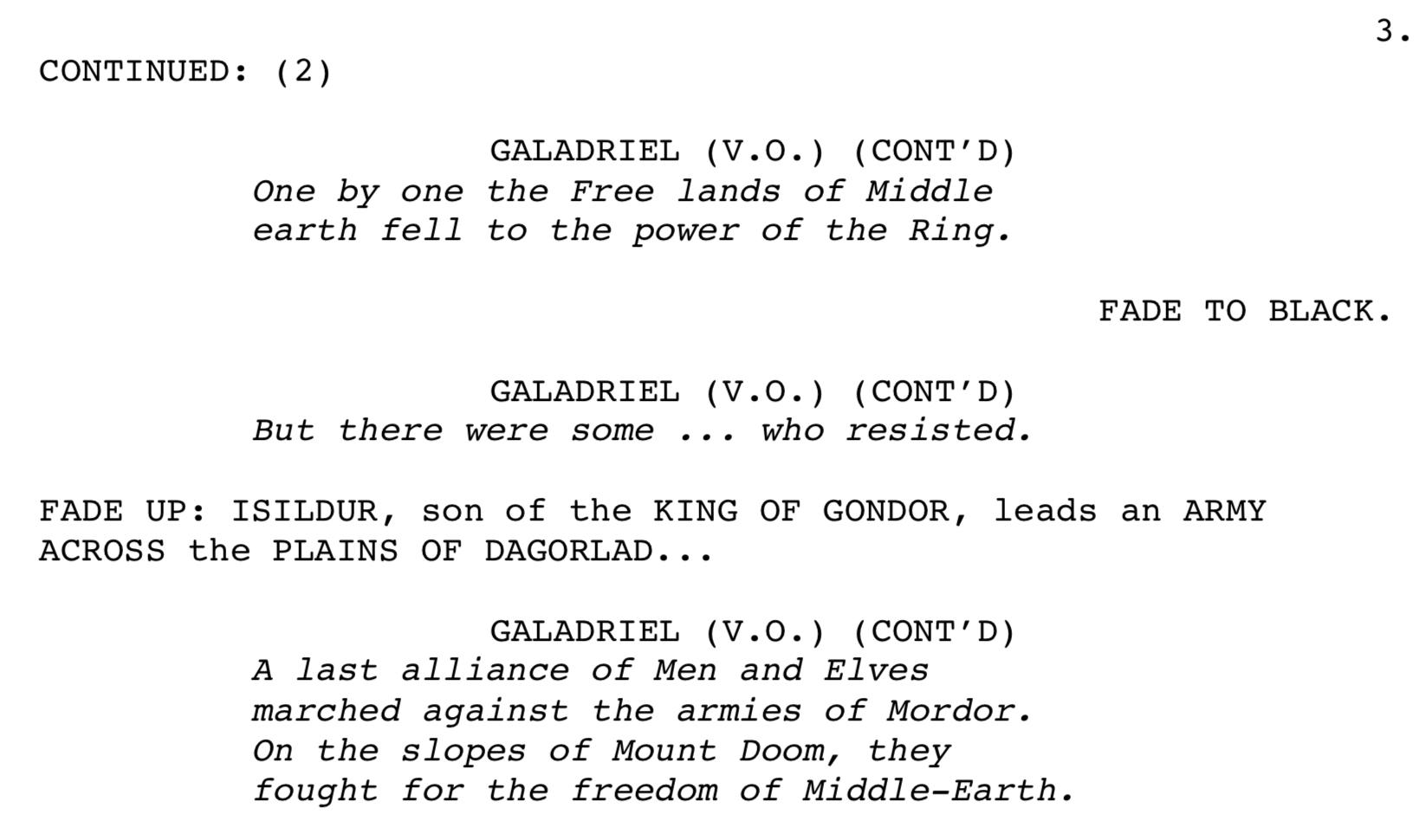
Notice how “Fade up” is aligned on the left, because it starts a new scene.
These transitions, though, are optional. They can clarify a scene change or add dramatic or comedic effect, but you don’t need to use them every time. More often, scene breaks are cued by a new location, like this:
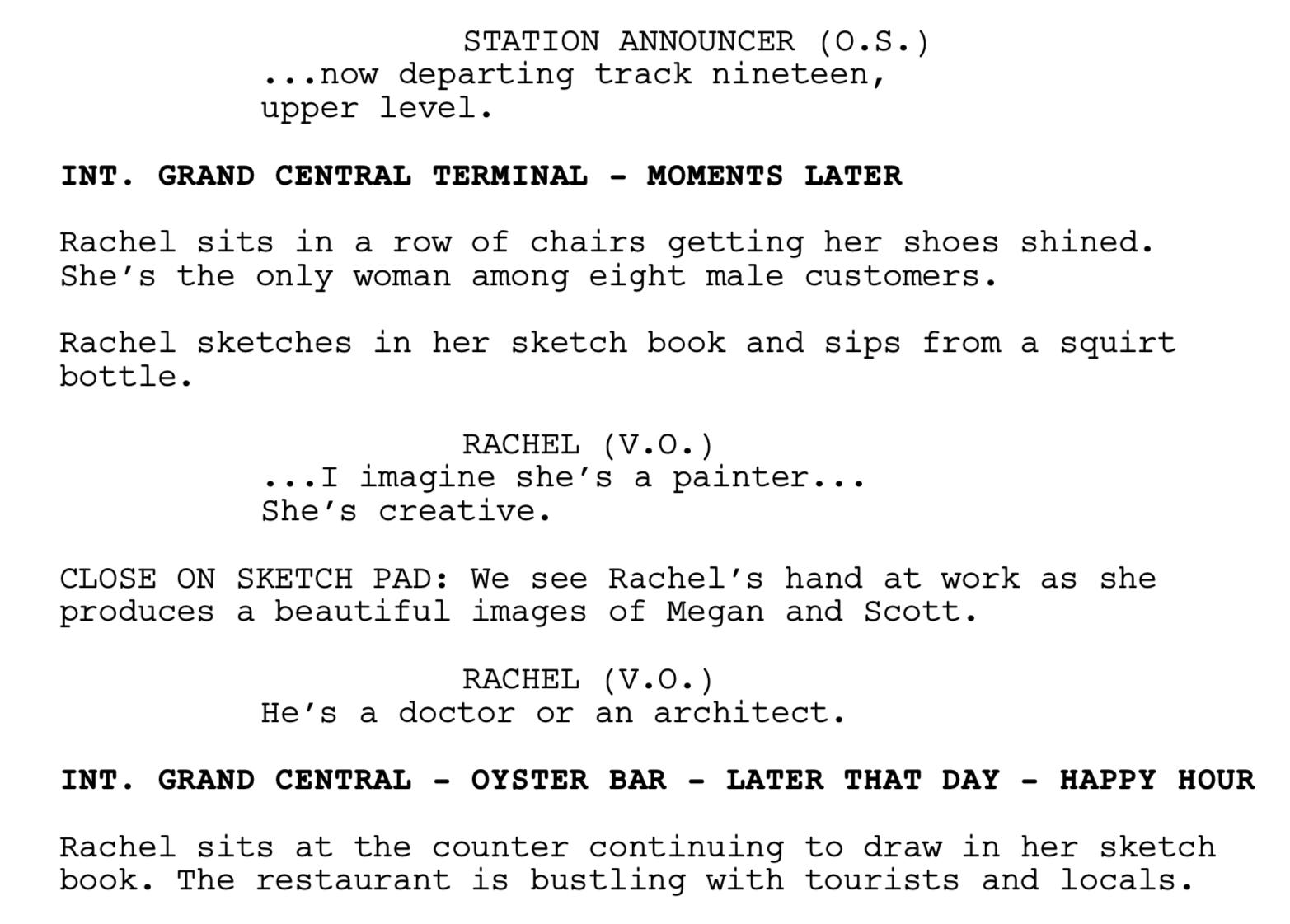
(This is from The Girl on the Train.)
A quick note on stage directions
We’ve looked at “Con’t” for “continued” after a line of dialogue. Some others you might use are “V.O” for “voice over”, “O.S” for “off screen”, or “O.C” for “off camera”. All of these mean that you can hear the character speaking, but they’re not physically present on the screen. These acronyms go beside the speaker’s name, in capitals.
Character actions or emotions, such as “to Jim” or “angrily” go underneath the name, bracketed and in lowercase letters.
Try to include enough description to tell the story clearly, but not so much that it overwhelms the story. Remember to leave enough space for the director’s and actors’ creative freedom.
In the final lines, there should be a scene transition (most often “fade to black” followed by the beautiful words “The End”, all in capitals. You can have a little fun emphasizing what kind of ending it is. Here are the final lines of Whiplash:
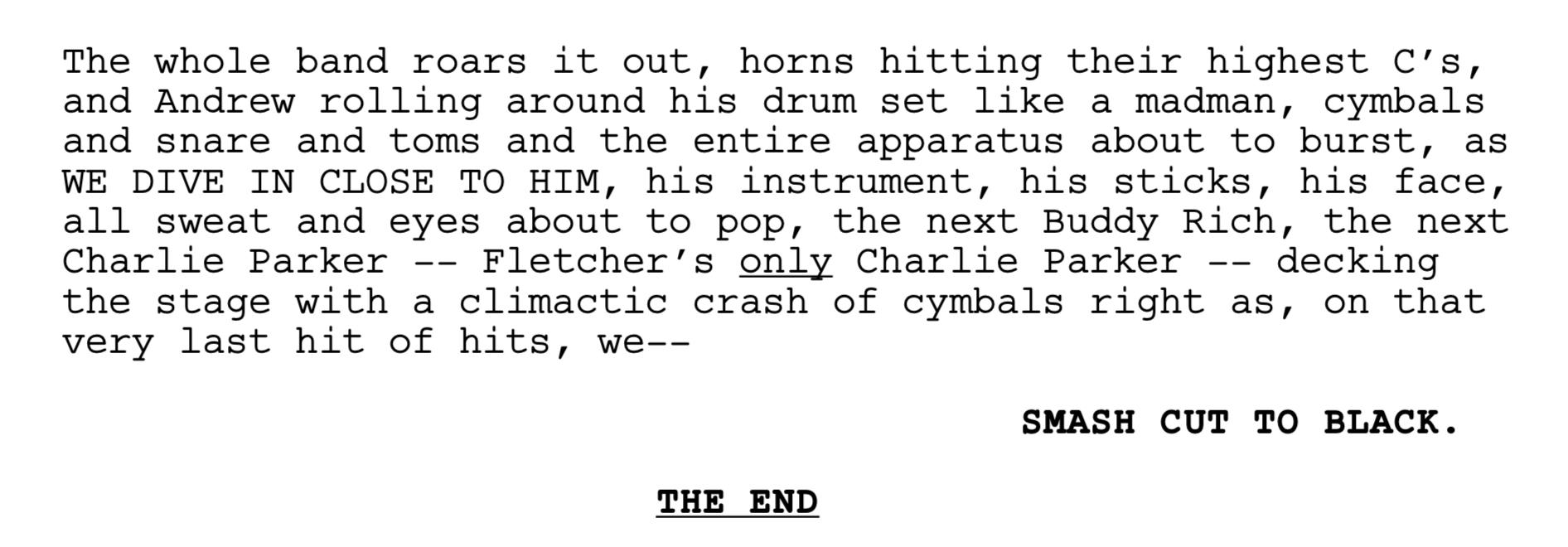
The best way to get this format under your fingers is to read a lot of screenplays. You can find a ton available to read for free here.
Elements of a good screenplay
Now that you have your screenwriter’s toolkit, let’s look at what separates a mediocre script (that doesn’t sell) with a truly great one (that gets picked up).
Complex characters
Creating compelling characters is one of the most important parts of any good story. Some of this will fall to the actors, not to mention the director—but it begins with you, the writer.
This means developing characters with nuanced motives, flaws, and backstories. Rise above the temptation of stock characters and instead create characters that feel like living, breathing people. This is of course easier said than done, but it comes with practice.
A driving central conflict
Conflict is the gasoline in your story engine. It propels the plot forward and pushes the characters to make difficult, exciting choices. Conflict just means that there’s a problem to be solved. You’ll often find the main conflict in the inciting incident, which is what gets the story moving and throws your protagonist and antagonist into opposition.
Conflict can be internal, external, or both. Internal vs. external conflict means the character is struggling either with a mental, emotional, or spiritual crisis of some kind or facing down an adversarial force that’s outside of themselves, fitting into classic types of conflict in a story. (Hint: great scripts find ways to use both.)
Tension and momentum
Tension, momentum, and suspense are how a film holds the audience’s interest. “Momentum” means that every story point builds on the one that preceded it, and informs the one that follows. But in between are little cliffhanger moments that leave the audience in suspense and have them asking, “What happens next?!”. That’s how you get tension and suspense.
There’s a delicate balance you need to reach between these “cliffhanger” moments, which raise a question, and the “resolution” moment that answers it. If you make the audience wait too long, the movie won’t have enough momentum and they’ll get bored. If you resolve the cliffhanger too fast, they won’t have time to become emotionally invested in the outcome.
Try watching some films in different genres to see how the filmmakers do this. You’ll see that the major beats form a pattern of question and answer, which keeps the audience invested.
A satisfying resolution
Nothing sinks a great movie faster than a terrible ending. It doesn’t matter how engaging your characters were or how thrilling your plot twists… if your audience doesn’t like the ending, they’re going to walk away unhappy.
A film’s ending should feel like a natural progression of the choices of its characters. This doesn’t mean you can’t surprise your audience; but, the surprise ending should make sense in retrospect with the world you’ve created. The audience should be able to look back and say, “Ahh, of course! It couldn’t have ended any other way.”
Bring those screenwriter dreams to life
Successful screenwriters know that a great movie doesn’t happen by accident. Box office hits are the product of meticulous planning and carefully crafted storytelling. Characters, conflict, action, and plot development are the building blocks you’ll use to shape your idea into a working screenplay that you can present to the industry with confidence.


